
Shop for Music
About the Composer

Abbie Betinis
Abbie Betinis Music Company
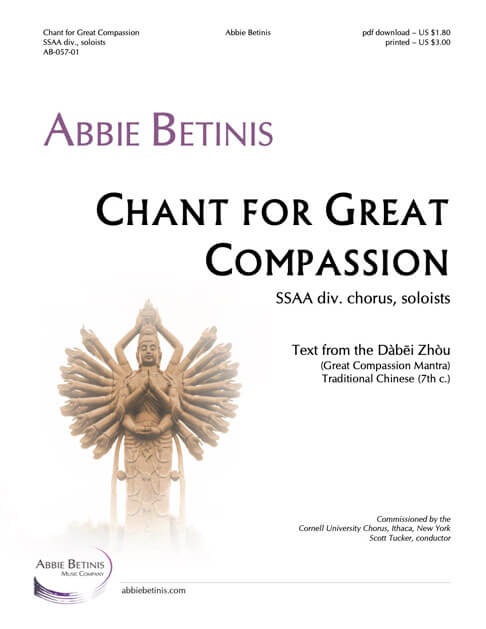
Chant for Great Compassion
A swirling, emphatic call for strength and courage in a world that is suffering.
SSAA div., soloists, a cappella
A centerpiece for advanced treble voices! Interweaving three Chinese texts with traditional melodies and her own incandescence and muscular assertiveness, composer Abbie Betinis creates a swirling force of prayer and positive energy for a world that is suffering.
The opening melody is inspired by the traditional chant to the goddess Guan Yin (meaning “she who hears the cries of the world”), known in Buddhism as the Chinese Bodhisattva of Compassion, who is revered for reaching out to all those who suffer, and for providing aid and relief to those in need. The second text is by Qiu Jin, a Chinese revolutionary, feminist, and writer. The third is the Great Compassion Mantra, also known as the Dàbei Zhòu, a centuries-old chant for protection, purification, and healing.
The Great Compassion Mantra is transliterated for those unfamiliar with the Chinese syllables, and the poems are recited in English, over a divisi choral underscoring that builds to an impassioned and earnest call for strength and courage. Use the aleatoric ending to feature your silvery soprano soloists on stage, or placed around the hall, to evoke a spirit of transcendence and hope.
Composer’s Notes
This piece is for anyone in any need or trouble. It is about calling out for strength and courage as individuals, and also on behalf of a generation.
The opening melody is inspired by the traditional chant to the goddess Guan Yin (觀音), whose name means “she who hears the cries of the world.” In Chinese mythology, Guan Yin is the goddess of mercy and compassion, an all-seeing, all-hearing being who is called upon in times of uncertainty, despair, and fear. Revered in China, Japan, and Taiwan, and her spiritual ancestor, Avalokiteśvara, in Malaysia, Tibet, and Thailand, one Buddhist legend describes her head splitting into eleven pieces as she attempts to comprehend the needs of so many. She is then given eleven heads to hear the world’s myriad cries (my inspiration for the 11-part chords on page 8). As she attempts to reach out to everyone who is suffering, her arms shatter into pieces. She is then given one thousand arms with which to provide aid and relief to those in need.
In China, fishermen pray to Guan Yin to ensure safe voyage. So with the traditional chant, I’ve juxtaposed the Qiu Jin text, written while she was traveling back to China by boat. Qiu Jin was a Chinese revolutionary, feminist, and writer. An eloquent orator, Qiu Jin spoke out for women’s rights: the freedom to marry, freedom of education, and abolishment of bound feet. She was tortured and publicly executed in 1907, at the age of 31.
The Great Compassion Mantra, also known as the Dàbei Zhòu, is an 84-line chant first translated from Sanskrit to Chinese in the seventh century. It is used for protection, purification, and healing. Because the Chinese version has been translated so many times and is spread widely through oral tradition, today the individual words have shed much of their original meanings. It now exists in many variations in East Asia and around the world, and is said to generate karma – even to the dead – upon its recitation.
This piece was written in response to the earthquake which took the lives of nearly 70,000 people in Sichuan Province in May 2008. But it is said that every recitation of the Great Compassion Mantra generates karma. I encourage singers to envision their own karma recipient(s) as they recite these enduring and beautiful syllables.
-Abbie Betinis
Text
LINES WRITTEN WHILE TRAVELING BY BOAT
I ride the clouds ten thousand leagues,
I left and now return;
My self alone in the eastern sea,
spring thunder at my side.
I cannot bear to see his map,
and so my face grows pale;
How can I let these rivers and hills
return to kalpa ash?
Cheap wine can never melt away,
the sorrow for my nation;
To save this age, we must rely
on talent beyond the common.
For we will risk this blood that flows
from one hundred thousand skulls –
And thus exert the strength to turn
the cosmos back in place.
– Qiu Jin, 1905, trans. Paul Rouzer
Used by kind permission of Paul Rouzer. This translation is under copyright, but may be reprinted from this website for use only as related to this musical work (i.e. in concert programs).
MIRROR
A precious mirror is shattered… (etc)
–Wang Erbei
This translation is under copyright and excerpted here only.
GREAT COMPASSION MANTRA
1. na mo ho la da nu do la ye ye,
2. na mo o li ye,
3. po lu je di sho bo la ye,
4. pu ti sa do po ye,
5. mo ho sa do po ye,
6. mo ho jia lu ni jia ye,
7. an,
8. sa bo la fa yi,
9. su da nu da sia,
10. na mo si ji li do yi mung o li ye,
11. po lu ji di, sho fo la ling to po,
12. na mo nu la jin cho… (mantra continues for 84 lines)
-traditional Chinese
This text is in the public domain and may be reprinted freely from this website. View the entire chant here: https://www.buddhamountain.ca/The_Great_Compassion_Mantra.php
$1.80 per licensed PDF






Reviews
There are no reviews yet.