
Shop for Music
About the Composer

Abbie Betinis
Abbie Betinis Music Company
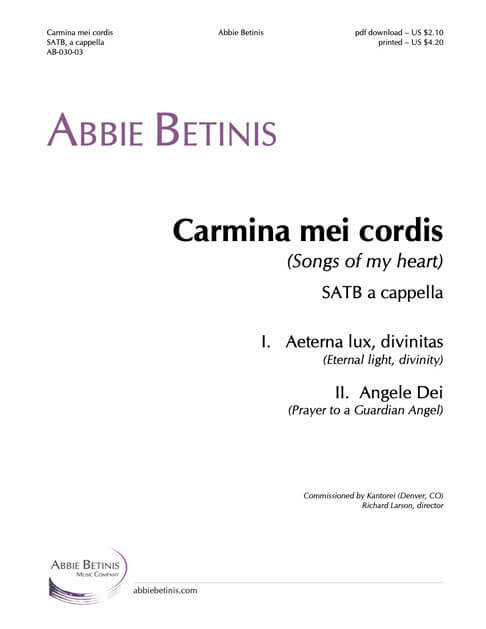
Carmina mei cordis (SATB)
Two contrasting Latin prayers summon eternal light by day, and protection and guidance by night.
SATB a cappella
I. Aeterna lux, divinitas (Eternal light, divinity)
II. Angele Dei (Prayer to a Guardian Angel)
This masterful set of two short pieces – one for daytime, and one for night – is one of the early titles that launched then 24-year old composer Abbie Betinis onto the choral scene. In Aeterna lux, divinitas (Eternal Light, Divinity), altos declaim quick Latin text before each voice part joins in, spiraling into a playful, energetic canon. The second piece, a soaring setting of the well-known evening prayer Angele dei (Prayer to a Guardian Angel), has harmonic roots in Poulenc and Messiaen, and a triumphant ‘Amen’ cadence that will ring in the rafters. Divisi in all voice parts is achieved through expert voice-leading, and short optional solos for alto (mvt. I) and soprano (mvt. II) give opportunities for individual singers to shine.
Composer’s Notes
Carmina mei cordis (Songs of my heart), is a set of two short pieces: one for daytime, and one for night. The first, Aeterna lux, divinitas (Eternal Light, Divinity) is an 18th century hymn from the Liturgia Horarum. Because the text hails the unity of the Trinity, the piece modulates between three tonal centers. They eventually spiral into a canon which encircles and unifies all voice parts in its course. The “Alleluia” refrain and playful soprano ‘swoops’ are my own additions to this Catholic text, which is traditionally prayed during daylight hours.
The second piece, Angele dei (Prayer to a Guardian Angel), was once attributed to St. Anselm, but scholars now trace this well-known evening prayer to the French writer and monk Reginald of Canterbury, who died in England sometime after 1109. Composed just after I returned from studying counterpoint in Paris, this musical invocation reflects my love for the choral music of Poulenc and Messiaen, and my own deep desire for spiritual peace.
– Abbie Betinis
Text
I. AETERNA LUX, DIVINITAS
Aeterna lux, divinitas,
in unitate Trinitas,
te confitemur debiles,
te deprecamur supplices.
Alleluia!
Christum rogamus et Patrem,
Christi Patrisque Spiritum;
unum potens per omnia,
fove precantes, Trinita.
Alleluia!
Qui finis et exordium
rerumque fons es omnium,
tu solus es solacium,
tu certa spes credentium.
Alleluia!
O veritas, o caritas,
o finis et felicitas,
sperare fac et credere,
amare fac et consequi.
Qui cuncta solus efficis
cunctisque solus sufficis,
tu sola lux es omnibus
et praemium sperantibus.
Alleluia!
-From the Liturgia Horarum, modified A.B.
II. ANGELE DEI
Angele Dei,
qui custos es mei,
Me tibi commissum pietate superna;
Hac nocte illumina,
custodi, rege, et guberna.
Amen.
-Attrib. Reginald of Canterbury (11th-12th c)
TRANSLATION:
I. ETERNAL LIGHT, DIVINITY
Eternal Light, Divinity,
O Unity in Trinity,
Thy holy name Thy servants bless,
to Thee we pray, and Thee confess.
Alleluia!
O Father, Source of God the Word,
O Word with Him co-equal Lord,
O Spirit of like majesty,
O Triune God, all praise to Thee.
Alleluia!
Thou First and Last, from whom there springs
the Fount of all created things,
Thou art the Life which moves the whole,
sure hope of each believing soul.
Alleluia!
O Verity! O Charity!
O Ending and Felicity!
in Thee we hope, in Thee believe,
Thyself we love, to Thee we cleave.
Thou who alone the world hast made,
art still its one sufficing aid,
the only Light for gazing eyes,
and, unto them that hope, the Prize.
Alleluia!
-Translation by R. F. Littledale (1833-1890)
II. ANGEL OF GOD
Angel of God,
my guardian dear,
To whom his love commits me here;
Ever this night be at my side,
To light and guard, to rule and guide.
Amen.
-Translation from Baltimore Manual of Prayers (1888)
$2.10 per licensed PDF



Reviews
There are no reviews yet.