
Shop for Music
Rose Publications (The Rose Ensemble)
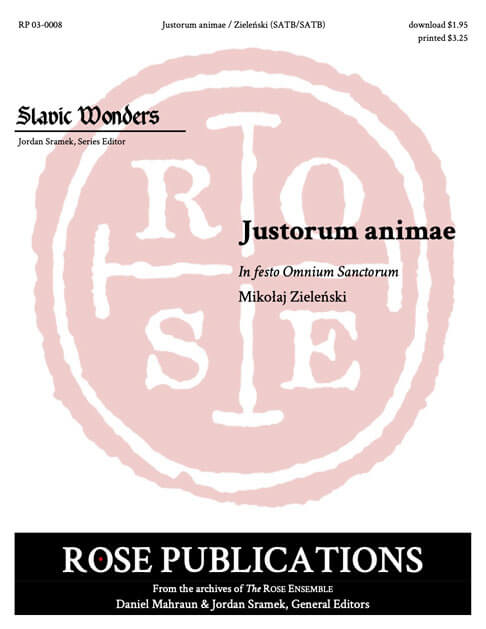
Justorum animae
Mikołaj Zieleński (fl. 1611) ed. Jordan Sramek and Daniel Mahraun
A bold, dramatic, double-choir motet from the Polish Renaissance.
SATB a cappella
Broadly sweeping phrases, rich bass lines, and intricate rhythms characterize this Latin motet for the Feast of All Saints.
Composer’s Notes
Zieleński’s compositions reveal much about the often-overlooked relationship between Poland and Italy during the late-sixteenth and early-seventeenth centuries, and how Polish composers—alongside local painters, architects, and even culinary artists of the time—took inspiration from fashionable Italy. From 1608 to 1615, Zieleński was in the service of Wojciech Baranowski, Archbishop of Gniezno, who, at the King’s instigation, sent Zieleński to study with Giovanni Gabrieli (c. 1557–1612), whose Sacrae symphoniae (1597) motivated composers from across Europe to come to Venice.
Zieleński’s 122 surviving works are contained in the 1611 Venetian publication, Offertoria/Communiones totius anni (dedicated to Baranowski), featuring liturgical cycles of polychoral works, as well as a handful of hymns, antiphons, three instrumental fantasias, and a remarkable 12-part Magnificat. The influence of the Venetian School is undeniably present in Zieleński’s compositions, which are reminiscent of the music Gabrieli himself was writing as principal organist at the iconic Basilica di San Marco.
Text
Justorum animae in manu Dei sunt,
et non tanget illos tormentum mortis.
Visi sunt oculis insipientium mori,
illi autem sunt in pace.
TRANSLATION:
The souls of the just are in the hand of God,
and the torment of death shall not touch them.
In the sight of the unwise they seemed to die;
but they are in peace.
– Offertory for the Feast of All Saints
$1.95 per licensed PDF







Reviews
There are no reviews yet.