
Shop for Music
About the Composer

Albert Pinsonneault
Graphite Publishing
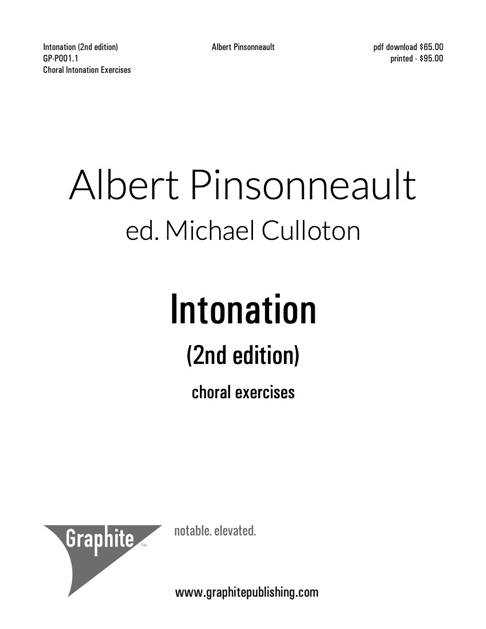
Intonation (2nd edition)
Choral intonation exercises to develop tuning, vowels, blend, and dissonance.
24 Choral intonation exercises, ed. Michael Culloton
The 2nd edition includes everything from the 1st edition plus 5 new exercises.
The $65 license allows you to make as many copies as needed of individual exercises for your school, church, or organization. Please note that some of the exercises are taught by rote, and the singers will not need paper copies.
“These choral intonation exercises have been most beneficial to the choirs at the University of Maryland. Since making them a regular part of our warm up and rehearsal routines, our singers’ awareness and sensitivity to both vertical and horizontal tuning issues have increased substantially. They are now able to assume much greater individual responsibility for the success of the entire ensemble for precise and accurate intonation. There is good flexibility within the exercises and any choir, from beginning to advanced, can improve by using them. I recommend them most highly!”
– Edward Maclary Director of Choral Activities School of Music University of Maryland
—-
“I once heard a conductor tell a room full of other conductors that singers don’t conspire to sing out of tune, and that it’s our job to help them hear their purpose in a piece. This collection of exercises will increase your choir’s awareness of pitch and function within a chord, and their intonation will improve quickly! Here’s a bonus that I know to be true: your singers will enjoy singing these exercises, too! (The exercises are like gummy bear vitamins… great tasting medicine!!)”
– Michael Culloton Assistant Professor of Music Concordia College, Moorhead, MN Concordia Chapel Choir, Männerchor, Cantabile
Composer’s Notes
Selections from the score:
Purpose
Contained within this book are exercises designed to strengthen the intonation and listening skills of a choral ensemble and its members.
Contents The exercises are organized in a graduated progression, moving from easier to more difficult. Various exercises concentrate on unison in a section or the entire ensemble, tuning consonant and dissonant intervals, tuning within functional harmony, alignment of vowels, and placement and intonation of various difficult intervals within a tonality.
Utilization
It is intended that one or a small number of these exercises be utilized at the end of vocal warm-ups, before moving on to the rehearsal of repertoire. The concentration and listening required to execute these exercises also brings a high level of focus to the ensemble prior to the rehearsal.
Pedagogy
Many choirs contain both individuals with advanced musicianship skills, and those who struggle to hear and replicate pitch with accuracy. Top choirs contain a higher percentage of advanced students while training choirs possess a lower percentage. Choirs at small institutions may contain an equal mix of both types. These exercises seek to strengthen listening and intonation skills of students of all abilities simultaneously. In addition, they strengthen one vital skill that cannot be practiced individually, fitting oneself into the texture of an ensemble.
This methodology is based on Edwin E. Gordon’s audiation theory. A musician must be able to first hear musical material in their mind before being able to produce that musical material with accuracy. These exercises seek to strengthen the ability of singers to anticipate their next sound, not only in pitch, but also vowel, dynamic, and timbre.
These exercises also seek to strengthen each singer’s understanding of tuning at an aural level. Too often blanket chords are used for intonation purposes and they are ultimately of limited usefulness. Perhaps the basses will become experts at tuning major triads when they are the root of the chord, but what about when we move beyond triads in root position? The exercises in this book understand that all members of the choir should be able to experience the pristine intonation of all intervals. Only after experiencing, hearing, and understanding good intonation can singers be expected to replicate it within repertoire.
Blend
Vowels, placement of production, dynamic uniformity, vibrato rate, and timbral uniformity can all effect intonation, the separation between intonation and blend can become grey. These exercises will result in the creation of choral blend, however, they do not specify that blend. Throughout the execution of these exercises, conductors are encouraged to adjust pitch, vowel, dynamic uniformity, placement of production, and balance of sections or chords to their own taste. I can not specify exactly the quality of vowels, nor can I specify exactly when a minor third is in “tune,” for numerous variations exist on both counts. Each conductor will have their own sense of vowels and intonation, as well as their own tolerance to ensemble uniformity, some desiring a highly homogenous “pristine” sound while others desire a more heterogeneous “colorful” sound.
Just as each conductor has their own ideal choral sound, the adjustments the conductor makes and encourages while working on these exercises with their ensemble will help steer the choir towards the conductor’s idea of blend and intonation.
Text
Forward for the 2nd Edition
A Note to the Director
Choral Intonation Exercises Table of Contents
Exercise #1: Audiation, Onsets, Blend
Exercise #2: Unisons of Pitch and Vowel
Exercise #3: Sliding into Vowel Alignment
Exercise #4: Perfect Pentachords
Exercise #5: Misaligned Pentachords
Exercise #6: Tuning the Major Mode
Exercise #7: Tuning the Minor Mode
Exercise #8: Tuning Mi and Me
Exercise #9: Tuning Non-Chord Tones Within the Modes
Notes on Exercises #10-23
Exercise #10: Chromatic Intervals Within the Fifth
Exercise #11: Tuning Within Changing Harmonies
Exercise #12: Expanding and Contracting into Consonance
Exercise #13: Chord Shifts
Exercise #14: Fifths in Audiation
Exercise #15: Controlled Dipthongs
Exercise #16: Fourths in Audiation
Exercise #17: Finding Balance in Harmony
Exercise #18: Suspensions as Accented Dissonance
Exercise #19a: Sharpening the Bass, Tempering the Soprano
Exercise #19b: Sharpening the Alto, Tempering the Tenor
Exercise #20: The Omnibus Progression
Exercise #21: Note Length and Rhythmic Intensity
Exercise #22a: Clockwork Chords
Exercise #22b: Clockwork Chords 2
Exercise #23: Rhythmic Arpeggiations
Exercise #24: Legato Blend
$65.00 per licensed PDF









Reviews
There are no reviews yet.