
Shop for Music
About the Composer

Shruthi Rajasekar
Shruthi Rajasekar Music
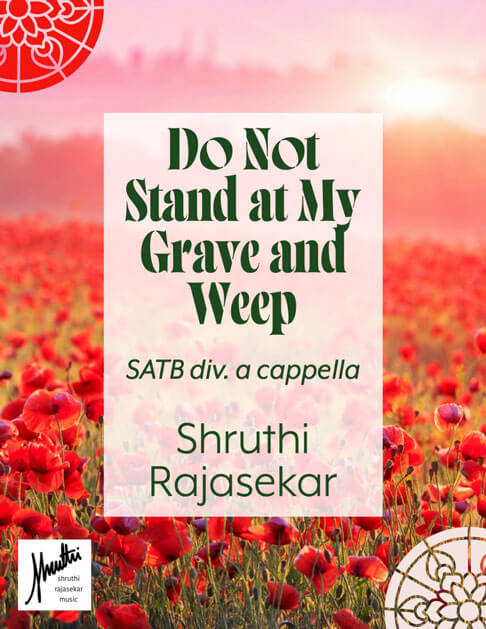
Do Not Stand at My Grave and Weep
Weaving together Indian melodic ragas, Rajasekar’s musical setting richly depicts the poem’s moods of loss and remembrance.
SATB div. a cappella
In this setting of Do Not Stand at My Grave and Weep, Shruthi Rajasekar captures grief, wonder, and hope. Using her deep roots as a practitioner of Indian classical music, the composer draws upon the cultural context of musical depictions of nature and emotions to weave together a ragamalika – garland of ragas – for this sumptuous choral work.
Composer’s Notes
Mary Elizabeth Frye’s beautiful poem has provided solace and comfort for generations of people across the world. Translated into various languages, this poem has traveled a long way from its origins as a text written to comfort a grieving friend. No matter its storied history, it remains a timeless source of peace.
I was personally drawn to Frye’s vivid imagery. The various depictions of nature inspired me to compose a ragamalika: a garland of ragas, the emotive scales of Indian classical music. This piece features Ragas Bhaskari,* Charukesi, and Kalyani. Above all, the quiet elegance of her text conveys a message of hope that I aspired to capture musically.
– Shruthi Rajasekar
*Note: Bhaskari is a relatively recent raga – to learn about its provenance, contact the composer.
Text
Do not stand at my grave and weep,
I am not there; I do not sleep.
I am a thousand winds that blow,
I am the diamond glints on snow.
I am the sun on ripened grain,
I am the gentle autumn rain.
When you awaken in the morning’s hush,
I am the swift uplifting rush
Of quiet birds in circling flight.
I am the soft stars that shine at night.
Do not stand at my grave and cry;
I am not there. I did not die.
– Mary Elizabeth Frye, 1932
$3.00 per licensed PDF
Music from Shruthi Rajasekar Music
-
-

-

-

Twelve Drummers
Difficulty: 3Duration: less than 3 min.





Reviews
There are no reviews yet.