Music for a Faith of Radiance and Reason
Enrich Your Repertoire with Favorites from Unitarian Universalist Music Professionals
Considering the wealth of teachings, rituals, stories and songs in the world’s religions, it’s easy to conclude they have little in common. But ask people what the core value of their own faith is, and you’re likely to hear the same answer: Love. Despite the inevitable missteps of religions (and there are many!), love lies at the heart of our most cherished celebrations. Music reminds us of this core value again and again, which is partly why the title of the Unitarian Universalist digital hymnal is Sing Out Love!
At a time when finding common ground can feel especially important, we found real joy in spending time with these hopeful, confident songs. We hope this music brings you joy, too, giving you ever more reasons to sing out love.
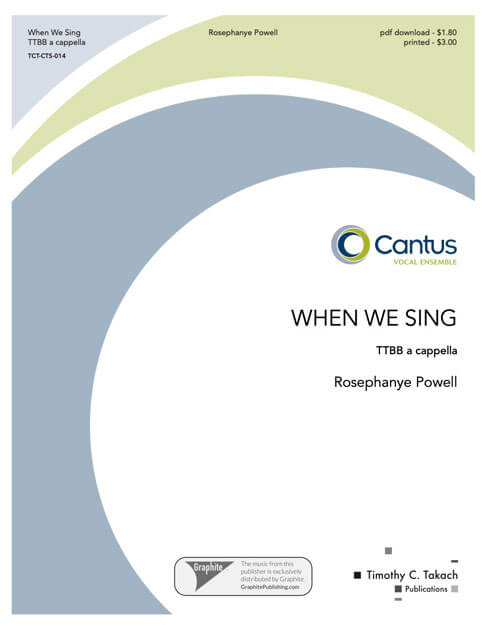
ELIZABETH: Rosephanye Powell’s When We Sing is published by the vocal ensemble Cantus in a series of its favorite compositions and arrangements. This piece grew out of the singers’ own conviction that singing together can be a powerful force for unity and empowerment. Powell based her original lyric on Cantus’ own words, carrying that conviction into every aspect of the music.
From the very first note, singers are invited to imagine themselves as one, contemplating the question “When we sing…” The answer arrives in a lively dance propelled by shaker, cabasa, or djembe.
At the heart of the song, though, is a lovely bridge in which the singers’ deepest dreams and aspirations unfold in a luscious close-harmony chorale. Voices lock into one another through breath, tone, phrasing, dissonance, and unity, achieving an expressive freedom rarely found outside of barbershop singing. Every word rings true and clear. And when the lively dance returns, it does so with greater purpose, and the result is pure percussive joy.
SAUNDER: Jen Cook’s evocative, lyrical writing shines in For You I Will Be an Island. Composed during the COVID-19 lockdown, the piece explores a quietly radical idea: that the greatest act of love can be distance itself. In a time when staying apart was the way we protected the people we cared about, isolation became a form of devotion, and Jen captures that paradox with real tenderness.
What struck me most was her expressive use of silence and space. Rather than filling every moment with sound, she lets pauses linger and textures thin out, so that the music itself seems to breathe in solitude. I think we rarely talk about how important silence is in musical composition. More than the word painting, Jen’s work is testament to how silence shapes musical expression.
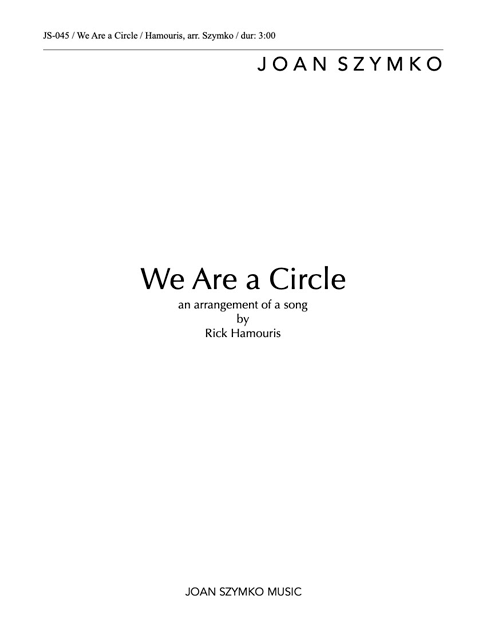
ELIZABETH: Joan Szymko’s powerful We Are a Circle, an arrangement of a chant by Rick Hamoris, draws us into community through driving rhythms and a refrain that invites us into the circle again and again. Its variations remind us that we are many different people traveling the same path. Invocations of Air, Sky, Water, Earth, and Fire remind us that we, too, are creatures of the earth, reaching toward its great mysteries.
Anyone familiar with Joan’s beloved classic It Takes a Village will recognize her gift for unfolding simple musical materials into rich, multilayered expressions of a singular message. That gift is especially evident in We Are a Circle, whose visceral power makes it an exciting choice for young or intergenerational voices.
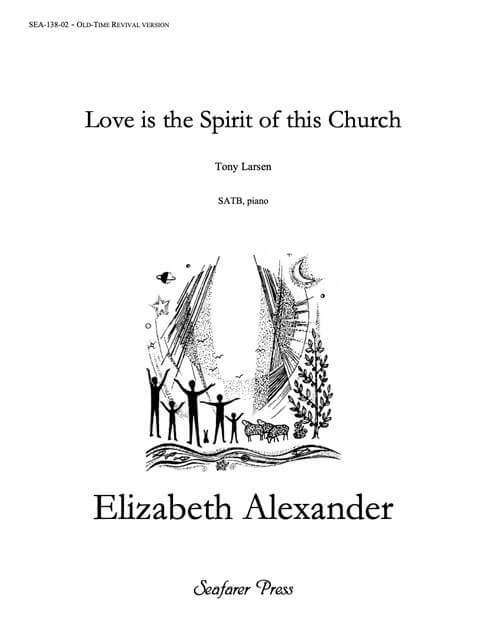
SAUNDER: “Love is the spirit of this church, and service its law/prayer.” These words form one of Unitarian Universalism’s most traditional congregational covenants, recited as part of worship in UU congregations around the world. It is fitting, then, that Elizabeth Alexander’s setting of Elisha A. Hoffman’s hymn is so thoroughly in service of the service itself.
In Love is the Spirit of this Church, Elizabeth builds flexibility right into the score. Two optional introductions leave room for the minister to speak, offer context, or set the tone before the choir launches into the old-time revival tune, carried along by an upbeat gospel accompaniment. There is even space in the middle for folks to share personal testimonies about where they see love at work in their spiritual communities, turning the piece into a true collective experience rather than a performance.
Musically, I especially love how scalar runs in the piano guide us seamlessly from one section to the next, and how carefully placed syncopations in both the voices and the accompaniment give the music its infectious joy.
ELIZABETH: Given this newsletter’s theme, “Sing Out Love!,” it’s no surprise that several songs envision the choir as one strong, unified voice. In To Imagine Creation, Saunder Choi takes this concept to a glorious new level. Knowing that the piece would be premiered in 2025 at the Kennedy Center, Saunder and poet Brian Sonia-Wallace set out to deliver an unapologetically inclusive message, a bold statement of solidarity with the marginalized and silenced.
The evocative language of Brian’s poem is a symphony unto itself. What it imagines is nothing less than the Beloved Community. The choir sings not only on its own behalf, but in service of every living soul:
“Our voices sing
For those who cannot be heard
The dispossessed and nameless
Their power stolen and dreams unspoken.”
The propulsive energy of the original chorus and orchestra version is driven by the sheer brilliance of Saunder’s orchestration, with the choir emerging as a clear, visionary ribbon of hope. That same vision carries through the chorus and piano version, which can be performed directly from the choral score.
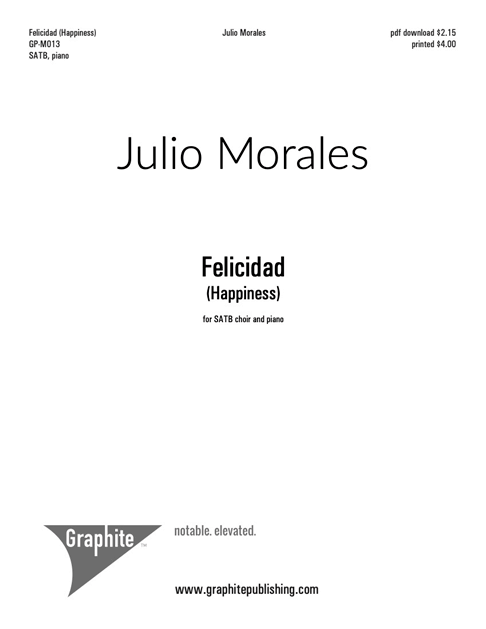
SAUNDER: Julio Morales’ Felicidad grapples with the small, everyday struggles that so often keep us from seeing the bigger picture and finding true joy. The lilting 6/8 meter flows beneath the piece like an undercurrent, a gentle reminder to savor small wins and simple pleasures, and not to let life’s hardships overshadow the good.
The harmonic journey mirrors this emotional one. The piece opens in D minor, tracing a path through “captive thoughts,” “valleys of illusion,” and “ropes that bind us,” images of the doubts and burdens that weigh us down. Then, at last, the music arrives in F major– triumphant and earned! The shift feels less like an escape and more like a homecoming. The brighter harmony was within reach all along, just as the happiness we search for is often already with us, in our homes and in the people around us. In the end, Felicidad suggests that true joy isn’t something we chase, but a practice we find within ourselves.
ELIZABETH: When composer Jocelyn Hagen couldn’t find the perfect text to express our essential interconnectedness, she asked her poet friend Julia Klatt Singer to create one. Inspired by the quiet dignity of forest trees, Standing Side by Side is a meditation on gratitude and resilience.
The best word I can find for Jocelyn’s setting is “stately,” but I don’t mean passive: there’s nothing passive about these trees. They withstand storms together, bend in the wind, and witness the beauty of the earth, remaining grounded through it all. More than that, just like the singers themselves, they breathe together.
Jocelyn is an accomplished pianist in her own right, and that gift is abundantly evident in the accompaniment’s full range of color. The piano’s warmth brings even more poignancy to the song’s message; after all, the soundboard itself was once a tree.
SAUNDER: It’s a Long Way is Brittney Boykin’s evocative setting of a poem by Boston-born poet William Stanley Braithwaite. Flowing gestures in the piano evoke sea-winds carrying a ship on a long voyage, an image Brittney uses to mirror the long journey the heart must travel before its dreams come true.
The song’s sense of hope lives in Brittney’s expressive melodic writing, which seems to hover and soar above the restless piano. Syncopations and hemiolas in the vocal line pull against the steady motion beneath it, creating a rhythmic tension that feels like longing itself. The form follows the strophic structure of Braithwaite’s poem, with each verse returning to the same rolling current, as if the journey is still underway.
Then, at the very end, the promise that “somewhere lies a shore” causes the piano’s driving motion to finally slow. It’s a striking moment of restraint: the dreams are not yet fulfilled, but they are not abandoned either. Instead, they carry on, flowing forward with time.




Composer and lyricist Elizabeth Alexander grew up in the Carolinas and Appalachian Ohio. Her love of music, language, and challenging questions is reflected in her catalog of over 150 compositions, many of which were written with liberal religious worship in mind. A Unitarian Universalist for over 40 years, she is an active member of Unity Church-Unitarian in St. Paul, MN.

LA-based Filipino-Chinese composer Saunder Choi brings the totality of his life experience to his work as a professional singer, immigrant, and LGBTQ+ advocate. In addition to his role as Director of Music at Neighborhood Unitarian Universalist Church in Pasadena, he was Music Coordinator of the 2022 Virtual Unitarian Universalist Association General Assembly and Music Director of the 2024 public worship service of Diverse and Revolutionary Unitarian Universalist Multicultural Ministries (DRUUMM).