
Shop for Music
About the Composer

Gerald Cohen
Gerald Cohen Music
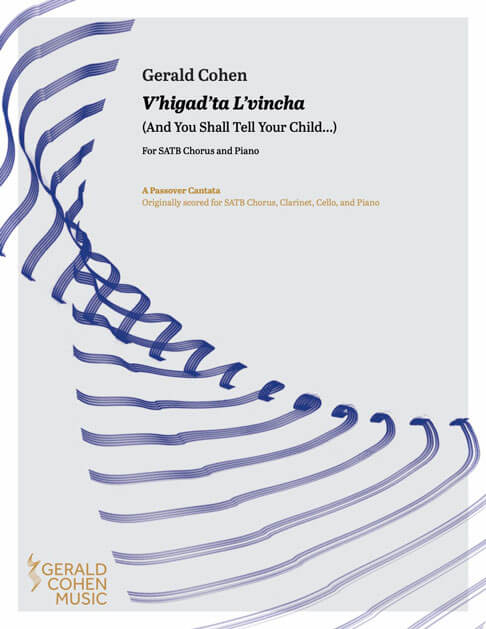
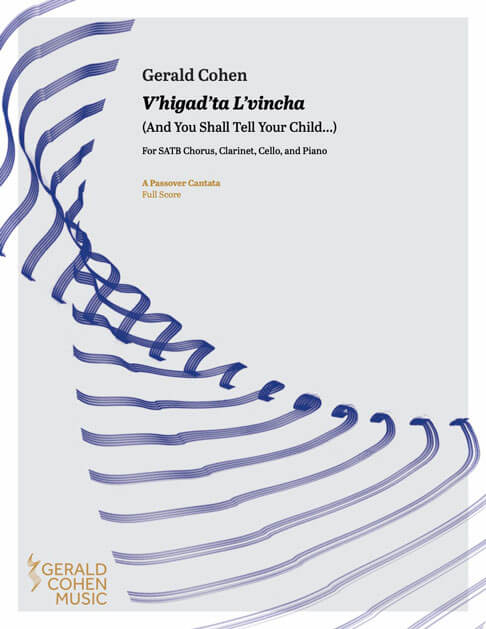
V’higad’ta L’vincha (And You Shall Tell Your Child…) (Choral/Piano Score)
A multi-movement piece retelling the Passover story of deliverance, inspiring future generations to pass down its enduring lessons.
-
V’higad’ta L’vincha (And You Shall Tell Your Child…)
-
Dayeinu! (It would have been enough for us)
-
Dayeinu! (It would have been enough for us)
SATB mixed chorus and piano
This is the Choral Score which accompanies the version for SATB mixed chorus, clarinet, cello, and piano, or which can be performed on its own.
Purchase includes a recording pronunciation guide.
V’higad’ta L’vincha (And You Shall Tell Your Child) is a powerful and joyful 16-minute piece celebrating Passover, in a setting of key passages from the Passover Hagadah. The Haggadah, or “telling,” is the text that is used at the Seder, the family meal—full of discussion, ceremony, and song—that is the central feature of the Passover celebration of freedom and rejoicing. One of the most significant themes of the Passover celebration, emphasized in Cohen’s choices of texts for the piece, is that we all must experience the story of the deliverance from slavery as if we ourselves had lived through it; we must then tell our children that story so as to pass it down, vividly, from one generation to the next.
The piece begins with a chant-like setting of the Biblical verse that instructs us to tell our children the story of the Exodus, and then moves, as does the Haggadah, from the oppression of slavery to the joy of deliverance. That joy is expressed especially in the famous text “Dayeinu” (“It would have been enough…”), set here as a lively dance, and in the final “L’fichach,” (“Therefore we should thank”) which gives gratitude to God in a procession which grows from a quiet beginning to an exuberant conclusion.
Available in versions for SSA chorus and for SATB chorus, V’higad’ta L’vincha was originally written with an ensemble of clarinet, cello, and piano, but can also be performed with just piano accompaniment. Several movements of the piece, particularly “Dayeinu” and “L’fichach,” are often performed as individual movements. Those programming the piece with full instrumental ensemble may purchase the Chorus and Piano scores for their choirs.
Composer’s Notes
V’higad’ta L’vincha (And You Shall Tell Your Child) was composed in 1996 for the Syracuse Children’s Chorus, Barbara Tagg, founder and director, and was commissioned by the Chorus as part of the “Commissioning Music/USA” program of Meet The Composer and the National Endowment for the Arts, with support from the Helen F. Whitaker Fund. As the transmission of the Passover story from one generation to another is a central theme of the Haggadah and of the piece, it felt most fitting to compose a setting of these texts in a work written for this wonderful children’s chorus.
-Gerald Cohen
Text
1. V’higad’ta l’vincha bayom hahu leimor: baavur ze asa Adonai li, b’tseiti mimitsrayim; ki v’yad chazaka hotsiacha Adonai mimitsrayim.
And you shall tell your child on that day, saying: it is because of what Adonai did for me when I went out of Egypt. For with a mighty hand did Adonai bring you out of Egypt.
2. Avadim hayinu l’faro b’mitsrayim, vayotsieinu Adonai eloheinu misham b’yad chazaka uvizro’a n’tuya. V’chol hamarbe l’saper bitsiat mitsrayim harei ze m’shubach.
We were slaves to Pharaoh in Egypt, and Adonai our God brought us out of there with a mighty hand and an outstretched arm. And the more one talks about the exodus from Egypt, the more praiseworthy it is.
3. Ha lachma anya, diachalu avatana, b’ara dimitsrayim. Kol dichfin yeitei v’yeichul, kol ditsrich yeitei v’yifsach. Hashata hacha, lashana haba’a b’ara d’yisraeil. Hashata avdei lashana haba’a b’nei chorin.
This is the bread of poverty which our ancestors ate in the land of Egypt. Let all who are hungry come and eat; let all who are needy come and celebrate the Passover. Now we are here; next year may we be in the land of Israel. Now we are slaves; next year may we be free people.
4. Kama maalot tovot lamakom aleinu!
Ilu hotsianu mimitsrayim, Dayeinu!
Ilu kara lanu et hayam, Dayeinu!
Ilu sipeik tsorkeinu bamidbar arbayim shana, Dayeinu!
Ilu keirvanu lifnei har sinai, Dayeinu!
Ilu natan lanu et hatorah, Dayeinu!
Ilu hichnisanu l’erets yisraeil, Dayeinu!
How many acts of kindness God has performed for us!
If God had brought us out of Egypt, Dayeinu! (it would have been enough for us!)
If God had split the sea for us, Dayeinu!
If God had sustained us in the wilderness for forty years, Dayeinu!
If God had brought us before Mount Sinai, Dayeinu!
If God had given us the Torah, Dayeinu!
If God had led us to the land of Israel, Dayeinu!
5. B’chol dor vador, chayav adam lirot et atsmo k’ilu hu yatsa mimitsrayim. Shene’emar: V’higad’ta l’vincha bayom hahu leimor: baavur ze asa Adonai li, b’tseiti mimitsrayim.
In every generation, each person should feel as if he or she had actually experienced the exodus from Egypt. As it is written: And you shall tell your child on that day, saying: it is because of what Adonai did for me when I went out of Egypt.
6. L’fichach anachnu chayavim l’hodot, l’haleil, l’shabeiach, l’faer, l’romeim, l’hadeir, l’vareich l’alei, ul’kaleis, l’mi sheasa lavoteinu v’lanu et kol hanisim ha’eilu. Hotsianu meiavdut l’cheirut, miyagon l’simcha, meieivel l’yom tov, umeiafeila l’or gadol, umishibud ligula. V’nomar l’fanav shira chadasha, Hal’luya!
Therefore, we should thank, praise, laud, glorify, exalt, honor, bless, extol, and adore the Power who performed all of these miracles for our ancestors and for us. God brought us from slavery to freedom, from sorrow to joy, from mourning to celebration, from darkness to great light, from bondage to redemption. Let us then sing a new song to God, Halleluya!
-Text from the Passover Haggadah
$6.00 per licensed PDF





Reviews
There are no reviews yet.