
Shop for Music
CORO Publishing
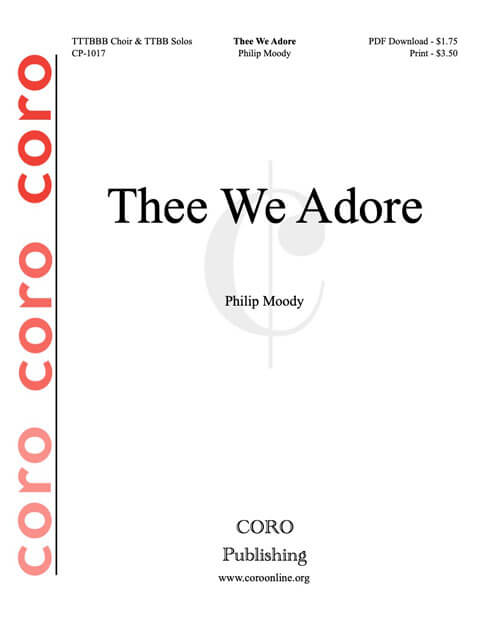
Thee We Adore (TTBB div.)
Philip Moody
Combines the gregorian chant tune, presented in an organum setting with the full men’s chorus, and alleluias from the solo quartet that have a more 21st-century style.
-
Thee We Adore
TTTBBB (TTBB Solos) a cappella
“Thee We Adore” is a piece that was inspired by Franz Biebl’s cherished setting of “Ave Maria.” I was still with Cantus, the full-time professional male vocal ensemble in Minneapolis, when the Biebl become a staple of our repertoire. For our first major tour of the east coast in the summer 1998, I wanted to write a piece that had some of the same ideas of flowing lines, chant-based melodies, and the antiphonal texture, but with a new twist. Thee We Adore combines the gregorian chant tune, presented in an organum setting with the full men’s chorus, and alleluias from the solo quartet that have a more 21st-century style.
Composer’s Notes
“Thee We Adore” is a piece that was inspired by Franz Biebl’s cherished setting of “Ave Maria.” I was still with Cantus, the full-time professional male vocal ensemble in Minneapolis, when the Biebl become a staple of our repertoire. For our first major tour of the east coast in the summer 1998, I wanted to write a piece that had some of the same ideas of flowing lines, chant-based melodies, and the antiphonal texture, but with a new twist. Thee We Adore combines the gregorian chant tune, presented in an organum setting with the full men’s chorus, and alleluias from the solo quartet that have a more 21st-century style. Although the piece is strophic and verse one and four are set identically, I was also drawn to the individual verses. The mood of the second verse seemed to bring me back to an earlier time and a simple unison delivery of the gregorian chant seemed to be the perfect choice. With the third verse, an image of an old outdoor fountain found within the gardens of an estate continued to come to mind. The bubbling water at the top that would flow down into many levels of shallow pools and then be sent back to the top to continue the journey reminds me of the goodness of God: his forgiving nature, his understanding and compassion that always flows forth. These ideas inspired the vocal fountain for the third verse found in the solo quartet.
– Philip Moody
Text
Thee we adore, O hidden Savior, Thee,
Who in Thy sacrament art pleased to be;
Both flesh and spirit in Thy presence fail,
Yet here Thy presence we devoutly hail.
O blest memorial of our dying Lord.
Who living Bread to men doth here afford;
Oh, may our souls forever feed on Thee,
and Thou, O Christ, forever precious be.
Fountain of goodness, Jesus, Lord and God:
Cleanse us, unclean, with Thy most cleansing blood;
Increase our faith and love, that we may know
the hope and peace which from Thy presence flow.
O Christ, whom now beneath a veil we see,
May what we thirst for soon our portion be,
To gaze on Thee unveiled, and see Thy face,
The vision of Thy glory and Thy grace.
Amen.
-Thomas Aquinas (1226-1274)
-English Translation by James R. Woodford
$1.75 per licensed PDF




Reviews
There are no reviews yet.