
Shop for Music
About the Composer

Paul John Rudoi
Graphite Publishing
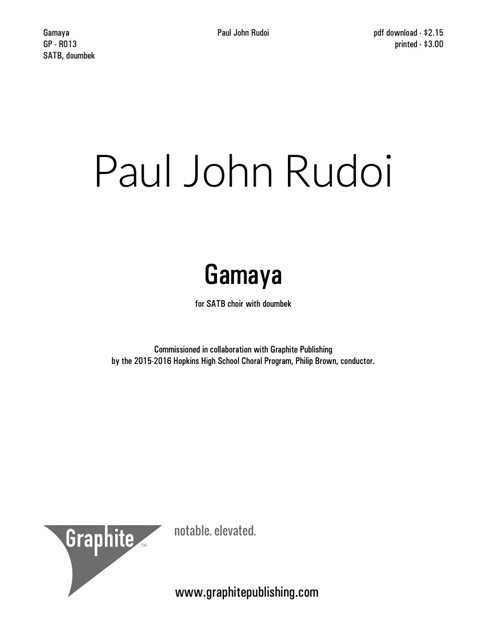
Gamaya (SATB) (Rudoi)
A mantra for peace and truth, written in canon.
-
Gamaya
SATB, opt. djembe
Commissioned in collaboration with Graphite Publishing by the 2015-2016 Hopkins High School Choral Program, Philip Brown, conductor.
This unique concert round is a perfect blend of elements: minimal, mantra-like vocal material but crafted and paced in a masterful way. The optional djembe adds a lot of depth to this piece, and the climactic section calling for peace will send chills down your spine. “Gamaya” can be learned quickly and effectively for a festival context and provides enough depth of musicality for other concert experiences.
Composer’s Notes
“Gamaya” is influenced by sound of ancient chants in Vedic Sanskrit, where the cantors would flirt with the upper halfstep and the whole step below the drone. It focuses on mantra-like repetition throughout the choir, another fascination of mine and an aspect of this ancient, sacred chant music. The piece in its published form is a concert work, but the main round in measures 3-18 can be used on its own. A choir could sing the round in unison, or as a 2- or 4-part round as designated, each new part coming in half a bar later, or each new part could come in a full bar later. The voicings are a suggestion, though this particular round works best with alternating ranges. The use of at least one drum is encouraged, and while earlier versions of the score mention djembe due to its availability, doumbek is preferred if available. If used, please adhere to entrances and exits notated with the diamond numbers in the score per the rhythms below. These rhythms are a basis, adaptable to the player’s skill level. Please also make sure any percussion supports the vocals, rather than obscuring them.
Origin and use
The text comes from the Brihadaranyaka Upanishad which is significant to Hinduism, so it’s considered a sacred text. Sanskrit is the primary language of Hinduism but it’s also a language used in other religions. Further, it was a cultural dialect and language used beyond sacred spaces at the height of its use in ~1500 BCE. To me this meant that I should connect with the spiritual and musical traditions surrounding the text more than keeping it in line strictly with Hinduism and/or sacred spaces.
Influences
This isn’t a traditional setting of the text. It’s my own setting after having immersed myself in where the text and its corresponding musical treatments originate. I came across the English translation first, then found the original, then dove into the musical and spiritual traditions around the text, let it digest, and then came up with my own melodic and harmonic construct (e.g. a home-base of a half-step, relying on mantra-like repetition, etc).
“Modern” Setting
My goal was to have the piece celebrate the origin of the text, the Vedic Chant tradition, and the tenets of Hinduism, specifically charity, ethics, and the goal of moving beyond this world to a different “reality” where inner and outer–and conscious and subconscious–peace is the goal.
If anyone feels uncomfortable performing the piece or using this language outside of a strictly sacred space or situation, I’d understand given the text’s origin. But to me, the message of the piece is universal and speaks to, ideally, a common ground we can all agree on… to continually aim for our better selves with the goal of peace.
– Paul John Rudoi
Text
asato mā sad gamaya,
From untruth lead me to Truth.
tamaso mā jyotir gamaya,
From darkness lead me to Light.
mṛtyor mā’mṛtaṃ gamaya,
From death lead me to Immortality.
oṃ śāntiḥ śāntiḥ śāntiḥ.
Om Peace, Peace, Peace.
– Brhadaranyaka Upanishad, I.iii.28
$2.15 per licensed PDF








Reviews
There are no reviews yet.