
Shop for Music
About the Composer

Joshua Shank
Graphite Publishing
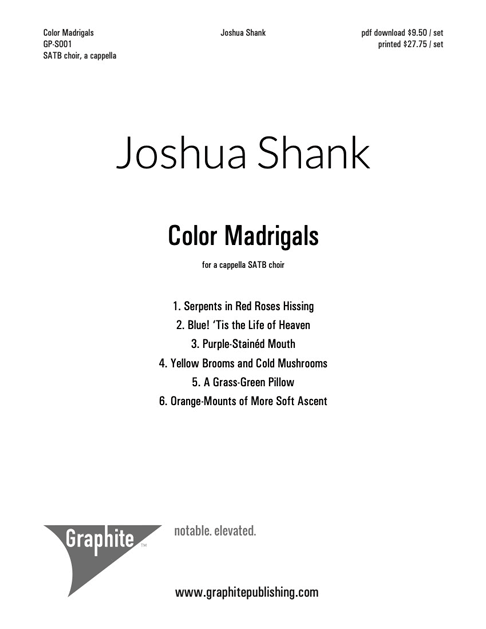
Color Madrigals (cycle)
A 6-movement choral song cycle, poetry by John Keats.
-
Serpents in Red Roses Hissing
-
Blue! Tis the Life of Heaven
-
Purple-Stainéd Mouth
-
Yellow Brooms and Cold Mushrooms
-
A Grass-Green Pillow
-
Orange-Mounts of More Soft Ascent
SATB a cappella
1. Serpents in Red Roses Hissing
2. Blue! Tis the Life of Heaven
3. Purple-Stainéd Mouth
4. Yellow Brooms and Cold Mushrooms
5. A Grass-Green Pillow
6. Orange-Mounts of More Soft Ascent
Color Madrigals is a 6-movement choral song cycle which uses poetry by John Keats as its text. Each movement corresponds to primary and secondary colors, and range from a quiet hymn (movement 2) to a barnstorming closer (movement 6). The set as a whole is appropriate for college-level choirs and above, and was commissioned by The Singers – Minnesota Choral Artists (Matthew Culloton, conductor) and The Summer Singers (Vicki Peters, conductor).
Composer’s Notes
Performance Notes
Because of the tight harmonies, little to no vibrato is desirable.
Take a breath only when indicated by a rest.
If a crescendo appears without a starting/ending dynamic it is based on the treatment of the text.
Program Notes
1. Serpents in Red Roses Hissing
This text starts off very simply as an exercise in dichotomy: every line contains two things which are diametrically opposed to one another. Keats takes this principle and seemingly works himself into a rhythmic frenzy until his poem sounds more like a witch’s incantation than a piece of poetry. But then, at line 23 (“O the sweetness of the pain!”), it suddenly turns into a beautiful elegy as he calls upon the Muses. After all this Keats ends up very simply in passion and sorrow over the grave of his beloved—a beautiful (and very human) ending to a poem that spends most of its energy invoking the gods.
2. Blue! ‘Tis the Life of Heaven
Of all the Color Madrigals, this text is the only one written about the actual color it takes its title from. Keats captures blue in all its forms by bringing the poem from the heavens to the ocean and finally back to the earth. Because of this, the poetry becomes more and more intimate as it progresses. I chose to write a gradually expanding hymn to create a sense of reverence for my own favorite color.
3. Purple-Stainéd Mouth
When I read this text for the first time, I always got stuck on the last two lines. I kept associating it with the image of someone whose heart is broken taking refuge in a bottle of wine. The eight lines of the poem that lead up to this are what this person wishes for but, in the end, probably doesn’t get. Anyone who has ever felt heartbroken knows this feeling and, although we usually heal ourselves of our own accord, “drowning your sorrows” can seem awfully inviting sometimes.
4. Yellow Brooms and Cold Mushrooms
The life of a satyr must be an easy thing. Essentially they just follow the wine-god around and spend most of their lives wrapped in joy and ecstasy in a drunken state of glee. I used some extended vocal techniques (glissandi, vocal “hiccups” and a violent, “drunken” key change) to portray the unpredictable nature of a jovial forest creature that’s had way too much to drink.
5. A Grass-Green Pillow
If there were a “standard” subject for poetry centered on the season of spring it would probably be the subject of love and, more specifically, new love. Luckily, the genius of Keats takes on this traditional theme with the amazing, poetic language and seamless rhyme he is known for. I gravitated towards this particular text because of the symmetry between the first and second halves of the poem. In the first two stanzas it sounds like the stereotypical, overzealous young man trying to woo a maiden who might be above him in social standing and may or may not return his sentiments. However, once you reach the midway point (and especially in the last stanza), it suddenly becomes much more tender and romantic—as if he suddenly figures out the difference between lust and love.
I’d like to think he chooses the latter.
6. Orange-Mounts of More Soft Ascent
It seems that Keats was not a fan of the color orange. I can’t say that I am either but, after undertaking the task of reading Keats’ collected works to find poems that mentioned colors, I wish he would have enjoyed it a little more because it seems that in his short life he only used the word “orange” once in his poetry. Granted that it’s one of those words that’s sort of famous for not rhyming with anything, but it still seemed ironic that in 458 pages the color only came up once.
That being said, I was lucky he decided to use it in a great poem. In the eight lines I excerpted Keats sprays invective on the prideful like a literary skunk (and even mentions another color in the process). He builds toward a final, desperate accusation to the heavens spitting out consonants like a great snake along the way.
A special note: I am especially indebted to Matthew Culloton and Vicki Peters for supporting the creation of such a large work. They and their respective choirs gave all six pieces amazing premieres in three different “volumes” (red/green, purple/yellow and blue/orange).
Text
The Texts
– John Keats (England, 1795-1821)
A Song of Opposites
Welcome joy, and welcome sorrow,
Lethe’s weed and Hermes’ feather;
Come today, and come tomorrow,
I do love you both together!
I love to mark sad faces in fair weather,
And hear a merry laugh amid the thunder.
Fair and foul I love together:
Meadows sweet where flames burn under,
And a giggle at a wonder;
Visage sage at pantomime;
Funeral, and steeple chime;
Infant playing with a skull;
Morning fair, and stormwrecked hull;
Nightshade with the woodbine kissing;
Serpents in red roses hissing;
Cleopatra regal-dressed
With the aspics at her breast
Dancing music, music sad,
Both together, sane and mad;
Muses bright and Muses pale;
Sombre Saturn, Momus hale.
Laugh and sigh, and laugh again—
O the sweetness of the pain!
Muses bright, and Muses pale,
Bare your faces of the veil!
Let me see! and let me write
Of the day and of the night—
Both together. Let me slake
All my thirst for sweet heartache!
Let my bower be of yew,
Interwreathed with myrtles new;
Pines and lime-trees full in bloom,
And my couch a low grass tomb.
Answer to a Sonnet Ending Thus:
“Dark eyes are dearer far than orbs that mock the
hyacinthine bell”
— J.H. Reynolds
Blue! ‘Tis the life of heaven, the domain
Of Cynthia, the wide palace of the sun,
The tent of Hesperus, and all his train,
The bosomer of clouds, gold, grey and dun,
Blue! ‘Tis the life of waters—Ocean
And all its vassal streams, pools numberless,
May rage, and foam, and fret, but never can
Subside, if not to dark blue nativeness.
Blue! Gentle cousin to the forest-green,
Married to green in all the sweetest flowers—
Forget-me-not, the blue-bell, and, that queen
Of secrecy, the violet. What strange powers
Hast thou, as a mere shadow! But how great,
When in an eye thou art, alive with fate!
Excerpt from Ode to a Nightingale
O, for a draught of vintage! that hath been
Cooled a long age in the deep-delvéd earth,
Tasting of Flora and the country green,
Dancing, and Provençal song, and sunburnt mirth!
O for a beaker full of the warm South,
Full of the true, the blushful Hippocrene,
With beaded bubbles winking at the brim,
And purple-stainéd mouth,
That I might drink, and leave the world unseen,
And with thee fade away into the forest dim—
Excerpt from Endymion
‘Whence came ye, jolly Satyrs! Whence came ye,
So many, and so many, and such glee?
Why have ye left your forest haunts, why left
Your nuts in oak-tree cleft?’—
‘For wine, for wine we left our kernel tree;
For wine we left our heath, and yellow brooms,
And cold mushrooms;
For wine we follow Bacchus through the earth;
Great god of breathless cups and chirping mirth!
Come hither, lady fair, and joined be
To our mad minstrelsy!’
‘Where be ye going, you Devon maid’?
Where be ye going, you Devon maid?
And what have ye there i’ the basket?
Ye tight little fairy, just fresh from the dairy,
Will ye give me some cream if I ask it?
I love your meads, and I love your flowers,
And I love your junkets mainly,
But ’hind the door I love kissing more,
O look not so disdainly.
I love your hills, and I love your dales,
And I love your flocks a-bleating—
But O, on the heather to lie together,
With both our hearts a-beating!
I’ll put your basket all safe in a nook,
And your shawl I hang up on this willow,
And we will sigh in the daisy’s eye
And kiss on a grass-green pillow.
Excerpt from Isabella; or, The Pot of Basil
Why were they proud? Because their marble founts
Gushed with more pride than do a wretch’s tears?—
Why were they proud? Because fair orange-mounts
Were of more soft ascent than lazar stairs?—
Why were they proud? Because red-lined accounts
Were richer than the songs of Grecian years?—
Why were they proud? again we ask aloud,
Why in the name of Glory were they proud?
FYI
If you’re not a rigorous student of the classics it can be difficult to read through the poetry and understand everything Keats is talking about. Listed here are some of the more obscure things he mentions in the course of his writing which, once you know what they are, can really make each text come to life.
Bacchus: the Roman god of wine.
Cynthia: the goddess of the moon and the twin sister of Apollo (the sun). She is more commonly known as Diana or Artemis.
Flora: the goddess of flowers
Hermes: the messenger of the Greek gods (known as “Mercury” in the Roman pantheon). He wears a winged hat and winged sandals to speed him to his destinations.
Hesperus: son of the Titan Iäpetus and the name of the planet Venus as it appeared after the setting sun. His three daughters (the Hesperides) are said to reside in a garden beyond the ocean.
‘hind: short for behind and should rhyme with mind, find, bind, etc.
Hippocrene: a spring on Mount Helicon in Boeotia, Greece which was sacred to the Muses and regarded as a source of poetic inspiration.
junket: a sweet, custard-like food curdled with rennet (a preparation or extract of the rennet membrane of a calf’s stomach used to curdle milk and make cheese, junket, etc.)
Lethe: One of the rivers of hell whose waters the souls of the dead drank after they had been confirmed for a certain space of time in the pit of Tartarus. It had the power of making them forget whatever they had done, seen or heard before.
mead: short for meadow and should rhyme with lead, deed, need, etc.
Momus: the god of pleasantry.
Provençal: originating from the Provence region of southeastern France.
Saturn: leader of the Titans who was defeated by his sons (Jupiter, Pluto and Neptune). He attempted to eat them for fear that they would overthrow him.
Satyrs: demigods of the country who attended Bacchus. They were represented by men with short horns and the legs and feet of a goat. They were known for their legendary propensity to party a lot.
$9.50 per licensed PDF




Reviews
There are no reviews yet.