
Shop for Music
About the Composer

Linda Tutas Haugen
Linda Tutas Haugen (Ephraim Bay Publishing)
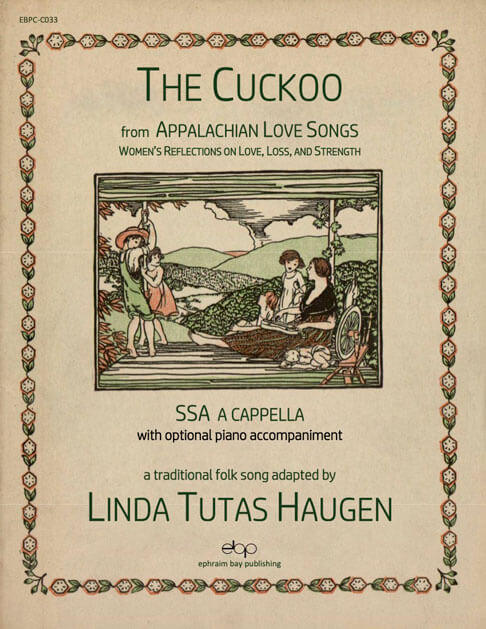
The Cuckoo
An excellent antiphonal piece!
SSA, piano
Performed a cappella or with an instrumental accompaniment of piano, dulcimer, guitar, banjo, or mandolin, this third movement of Appalachian Love Songs portrays strength and resiliency in its text and setting! The song is ultimately felt in “one,” with a floating accompaniment, above which the “round” flows and soars. An excellent antiphonal piece!
Composer’s Notes
Earliest mentions of The Cuckoo date at least back to 1796 and 1802 in Scotland, according to Jean Ritchie in her collection, Southern Mountain Folksongs. The text consists of “floating verses” that are found in and out of several other songs, which result in the many versions that exist in the UK and Appalachia. The one verse that appears constant is the first verse in this text, which refers to the cuckoo bringing good tidings. The remainder “floating” verses usually contain sad warnings of “false true love.” This particular combination of verses also indicates resilience in the singer in the last two stanzas.
The cuckoo bird itself, has a rich association with folklore and is used symbolically as the bringer of spring (or summer in Britain), is said to predict the number of years a marriage will last, how long a man will live (both based on the number of times it is heard in a season), and to be a good omen for lovers. With its seasonal relationship, it is often linked with both sexuality and unfaithfulness.
Cecil Sharp and Maud Karpeles collected 13 variants of The Cuckoo in KY, NC and VA from 1917-18. This setting incorporates elements of a variant from Knott Co., KY sung by Elsie Combs in 1917 and also a variant by Jean Ritchie, Knott Co., (Folk Songs of Southern Appalachia), and is modified with changes in meters, note durations and text.
– Linda Tutas Haugen
Text
Oh, the cuckoo is a pretty bird,
She sings as she flies,
She brings us glad tidings,
And she tells us no lies.
She sips all the lovely flowers
To keep her voice clear,
And she never sings “cuckoo”
Till the spring of the year.
Come all you young women
And listen to me,
Never place your affections
On a green growing tree.
For the leaves they will wither
And the roots will run dry.
And you’ll be forsaken
And never know why.
My true love has forsaken me,
I’m sure he’s foresworn,
He’s badly mistaken
If he thinks I will mourn.
I’ll get myself up
In my best finery,
I will walk proudly by him
As he walks by me.
– Traditional English Folk Song
$2.35 per licensed PDF



Reviews
There are no reviews yet.