I’ve been a choral singer for almost thirty years, and in that time I’ve sung a large-scale work only eight times (five were Messiah). The others (Bach’s St. John Passion, Rachmaninoff’s All-Night Vigil, and Craig Hella Johnson’s Considering Matthew Shepard) stand out not only because or their rarity, but because they required something fundamentally different from me: a willingness to live inside a single musical world for weeks, sometimes months, before it revealed its full scope.
For singers, these projects can feel less like a concert and more like a pilgrimage. Each rehearsal is another waypoint that uncovers another musical layer, but the destination only comes into view near the end.
The word we often use for such pieces is “masterwork,” a term that arrives at rehearsal like an uninvited guest: weighted, complicated, and difficult to ignore. Its roots lie not in art but in labor: in the guilds of medieval Europe, a “Meisterstück” was the work a journeyman produced to prove his skill before becoming a master craftsman. There was nothing transcendent implied — no divine spark, no immortal genius — just a test piece, judged by peers.
The Romantics later stretched the word toward perfection, turning it into a vessel for genius. Some now prefer “major work” or “large-scale piece,” but the weight of “masterwork” lingers, inviting both reverence and suspicion.
What distinguishes a so-called masterwork from the octavos that fill most concert seasons is not merely length. A composer conceives differently when given the space of an hour instead of six minutes. An octavo is a beautifully intricate sketch; a large work is a fully-engineered architecture.
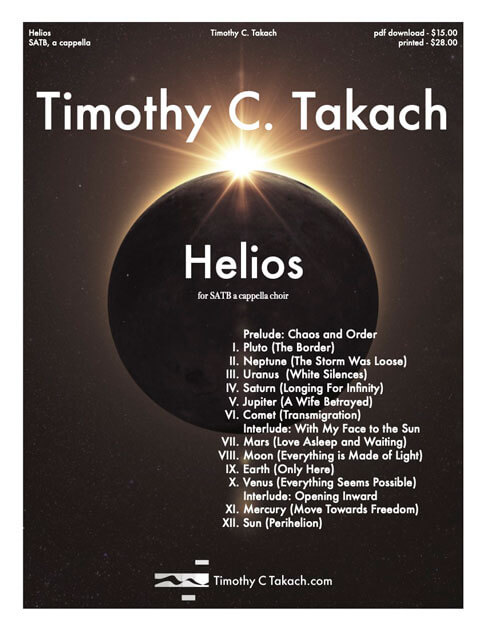
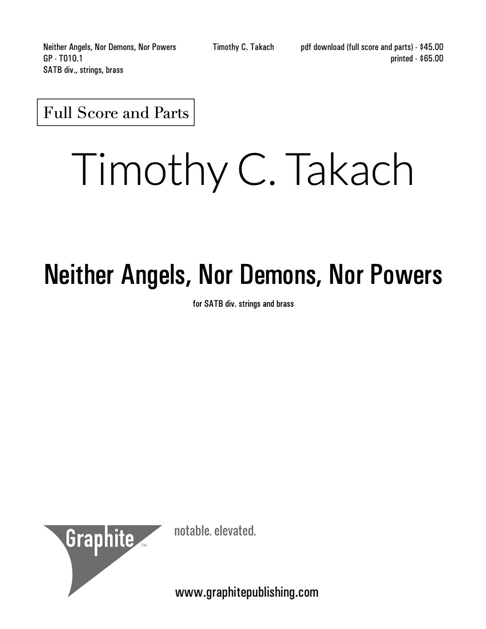
In Helios, composer Timothy C. Takach imagines a choral cosmos: twelve movements tracing the arc from chaos to creation, each planet rendered in shifting sonorities and mythic color. Over an hour, motifs recur like constellations, textures expand and contract, and the choir seems to orbit its own light. By contrast, Takach’s “Neither Angels, Nor Demons, Nor Powers” compresses its theology into four concentrated minutes — a single act of faith articulated in a disappearing flash compared to the larger work. The difference is not just duration but dimension: Helios invites us to dwell inside an evolving universe, while “Neither Angels” offers a burst of illumination — the sacred caught and released in one radiant instant.
To sing an octavo is to pass quickly through a room; to sing a large-scale work is to inhabit a cathedral. The longer form allows for sustained argument, unfolding tension, and a grander catharsis. These cathedrals of sound ask for more than imagination; they ask for commitment.
But these larger works also demand risk: money, stamina, time, and reputation. For choirs, the rehearsal schedule is upended. Budgets balloon to pay for soloists, instrumentalists, or scores. For composers, the stakes can be higher: years of work invested in a piece that may only receive a handful of performances (or only one).
Still, when a large work succeeds, the reward is disproportionate. Singers grow in confidence and cohesion, finding reserves of endurance and artistry they didn’t know they had. (I remember how proud I was when, as a 19-year-old, I made it through Messiah that first time.) Audiences, too, recognize the difference: they are invited not into a series of appetizers but into a meal that lingers in memory — one they help finish simply by listening.
As a professor as well as a singer, I was asked a few years ago to perform in a semi-staged rendering of Craig Hella Johnson’s Considering Matthew Shepard. During a lull in rehearsal, two undergraduate tenors and I confessed to one another how difficult it was to sing certain portions of the oratorio which set to music some of the hateful rhetoric surrounding Shepard’s murder. Johnson includes that language deliberately, so the rest of the oratorio can move toward redemption. In an octavo, those dark moments would have dominated, but a large-scale piece can hold that much ugliness and still lead us to light.
Achieving that musical and emotional luminosity by the end of Johnson’s work — defeating the hatred — brought the choir, and the community that surrounded it, together in a shared sense of purpose. Other university faculty joined in by adding readings on homophobia and the Shepard murder to their syllabi, while members of a local LGBTQ+ choir provided narration for some of the spoken parts.
This is an example of how large works can galvanize not just a choir but a whole community. A performance of Beethoven’s Ninth or Brahms’s Requiem is an event, not just a concert. The collective energy of singers, players, and listeners builds something greater than the sum of its parts. And for the singers, there is a kind of transformation that can’t be replicated in shorter works. A personal example that comes to mind was performing Rachmaninoff’s All-Night Vigil with the Minneapolis-based choir, The Singers. The ensemble walked away from that concert with a deep sense of accomplishment (having just mastered an hour-long work sung in Church Slavonic) and were subsequently invited to Chicago’s Ravinia Festival a few years later to present their hard work and nuanced interpretation.
Most of the canonical masterworks are centuries old, written in contexts far removed from our own. They still carry profound value, connecting us to the sweep of history and the endurance of human expression. But new large-scale works invite us into something different: they speak in our idioms, wrestle with our anxieties, and confront our histories directly. Jocelyn Hagen’s amass folds the ancient Mass form into a dialogue among many faiths. Setting Latin prayers beside poetry from Sufi and Hindu mystics, Hagen transforms ritual into reflection, turning the cathedral inward. The result feels both reverent and restless: a vision of the sacred remade for a plural age.
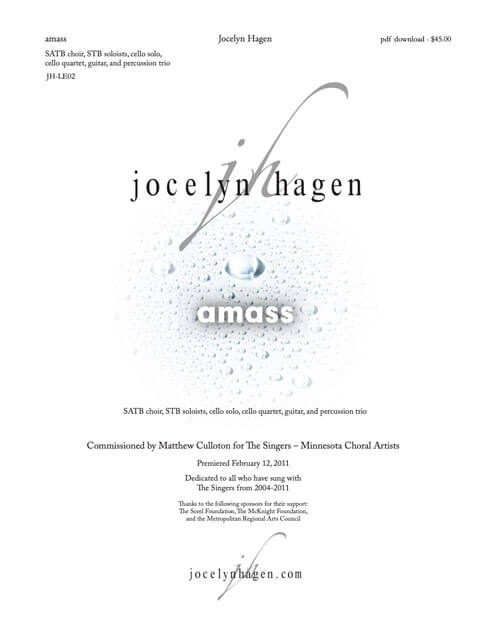



Newer large-scale works remind us that the canon is not fixed, that our time also produces pieces that deserve to be remembered, programmed, and passed along.
But if these works are so rewarding, why are they so rare? The obstacles are real: budget, rehearsal time, audience appetite. But choirs have found creative ways to manage the risk:
• commissioning or performing shorter large-scale works rather than, say, the Missa solemnis,
• pooling resources in commissioning consortiums,
• saving over time for a more broad-shouldered work once every few years, or
• reimagining presentation to make a larger work more accessible.
Far from being deterrents, these strategies can expand ownership, deepen commitment, and build excitement around the premiere of a new piece.
The question remains: which of today’s large-scale works will enter the canon? Just as Messiah or Carmina Burana once seemed daring, some choirs may still be singing today’s works a century from now. Yet if we shy away from programming them, they may never get the chance to prove themselves. To build a canon is not only to preserve the past but to take a chance on the future.
The eight times I’ve sung a large-scale work across twenty-five years remain some of the most vivid memories of my musical life. They demanded more of me, and gave back even more.
A large work gathers people into its gravity — singers, players, audience — all pulled into a shared orbit for an hour or more, until time seems briefly suspended. When the final chord fades, what lingers isn’t perfection but presence: the memory of having stood inside something vast and human, built out of breath and trust. For those who plan the seasons ahead, the challenge is to risk that gravity — to make space for the kind of work that can transform not just a concert, but everyone who takes part in it. That, more than mastery, feels like the point.
Every choir deserves, at least once, to feel the world widen like that.

Joshua Shank is a collaborator who’s lived on both U.S. coasts and borders. When he’s not busy thinking up new musical ideas, burning lentils in the pursuit of vegetarian mastery, or cackling at cinematic disasters with his husband, he’s advocating for marginalized voices through his work.