Shop for Music
About the Composer

Timothy C. Takach
Timothy C. Takach Publications
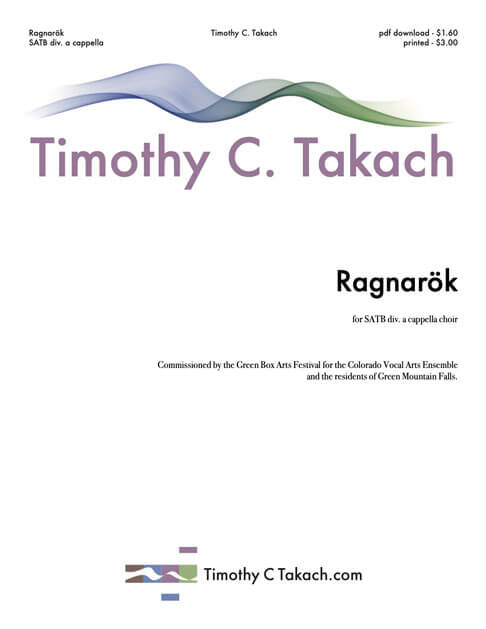
Ragnarök
Old Norse myth and contemporary poetry combine for an epic journey of destruction and rebirth.
SATB div. a cappella
Norse mythology and vivid sonic landscapes make Takach’s “Ragnarök” an epic journey. Portions of the Norse Poetic Edda: Völuspá are set alongside a contemporary poem about the 2012 Colorado fires, bringing the old and the new, the myth and the reality together in an emotional cycle of destruction and rebirth. The writing is rich, sensitive, fiery and dramatic, asking singers to embody the story as they sing. This piece is a centerpiece of any program with themes of nature, life cycles, hope, ancient texts or community.
Composer’s Notes
Ragnarök is a story in Norse mythology that is supposed to bring about the end and rebirth of the world. During the battle between Gods and Giants the world tree, Yggdrasil, remains standing, and from it we see new life emerge. There are parrallels between the natural disasters in Ragnarök and the 2012 fires in Colorado, and so this ancient text is woven into a contemporary poem about the Waldo Canyon fire that covered 29 square miles near Colorado Springs.
This mixture of ancient and contemporary poetry ties the work together, so we hear both English and Old Norse together in the singing of certain runes from the Elder Futhark (the oldest form of the runic alphabets). These runes foreshadow the drama to come, and musically they provide a textural backdrop against the narrative of the Völupsá text (this is the poem that includes the story of Ragnarök).
The music that accompanies “The Fires” has a resigned tone to it, but it also features a repetitive rising motion that not only represents rising smoke but also a hopeful determined outlook toward the future. At the end of the piece, this motive comes back in a major key, and indeed we hear hope as the earth returns to normal and nature resumes her course.
– Timothy C. Takach, 2017
Text
Hagalaz (wrath of nature), Sowilo (sun)…
Dark grows the sun,
and in summer soon
Come mighty storms:
would you know yet more?
Brothers will fight one another
and kill one another
the world will be a hard place to live in.
skeggold, skalmold, (an age of the axe, an age of the sword,)
vindold, vargold, (an age of storms, an age of wolves,)
Before the world sinks in the sea,
there will be no man left who is true to another.
The old tree sighs
when the giant shakes it—
Yggdrasil still stands,
but it trembles.
Skelfr Yggdrasils
askr standandi.
The sun turns black,
the earth sinks into the sea,
the bright stars
fall out of the sky.
Flames scorch
the leaves of Yggdrasil,
a great bonfire
reaches to the highest clouds.
Here is a house,
here is a neighborhood.
Here is a street, a door, a room, a window.
Here is a drought, here a beetled pine.
Here is a wildfire leaping from limb to roof.
There is a law of lightning, law of wood.
There is a need to burn, to lose, to grow.
There is the charred scar, there the flying ash.
To dwell is not to shelter, we should know.
Here are the people packing their cars to flee.
Here are the photos in frames, the pets on leashes.
Here are the children bewildered, coughing smoke.
Here are the firemen climbing the hills in the heat.
Berkana (growth), Dagaz (day)…
I see the earth
rise a second time
from out of the sea,
green once more.
Waterfalls flow,
and eagles fly overhead,
hunting for fish
among the mountain peaks.
We are the street, we are the neighborhood.
We are the garden living and dying to bloom.
We are the parched yards, we are the trembling deer.
We are the long walk looking to find our home.
I see the earth rise a second time.
Rise.
– Poetic Edda: Völuspá (41, 46, 55, 57), translated by Dr. Jackson Crawford, sung in English and Old Norse. Used with permission. “The Fires,” by David Mason. Used with permission.
$2.15 per licensed PDF