Shop for Music
About the Composer

Timothy C. Takach
Timothy C. Takach Publications
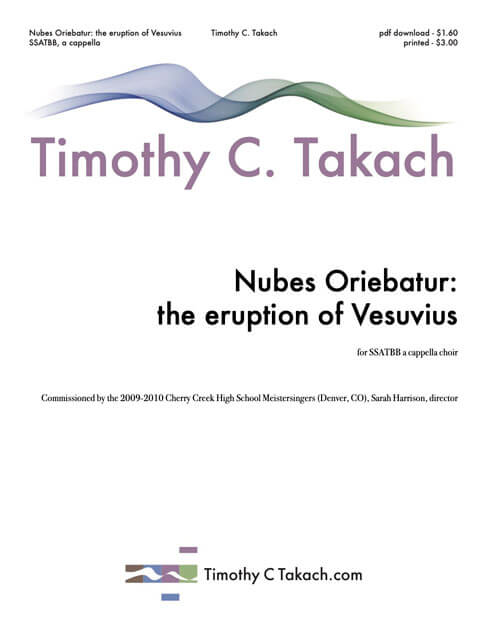
Nubes Oriebatur: The eruption of Vesuvius
A wonderfully evocative piece, singers will delight in the vibrant harmonies and accessible melodic gestures.
SSATBB a cappella
Sung in the original Latin, Takach has painted a vibrant landscape in which we can hear the turmoil that must have surrounded the eruption in 80 AD. Clashing harmonies lie above murmuring bass lines and cellular melodic development. “Vesuvius” is through composed, and allows the singers to paint the landscape with their words and phrases. This piece is an amazing addition to your choral library and your next program.
Composer’s Notes
I loved the chance to set this text, the words appealed to me on many levels. Pliny’s descriptions are so vivid and poetic, and appropriately so, since he was there when Vesuvius erupted. I loved the idea of setting the original Latin, even though the immediate meaning of the words would be obscured to just about every listener, because it gave me the chance to capture the colors, gestures and images of the words without feeling like I was painting the text too obviously. The feelings and emotions evoked here are real – this isn’t a myth or folk tale. This event actually happened to real people. Some escaped with their lives, many did not. I hope that this music captures the awful beauty of this dreadful eruption.
– Timothy C. Takach
Text
Nubes oriebatur.
(Praecesserat per multos dies tremor terrae.)
Nubes oriebatur, cuius similitudinem et formam non alia
magis arbor quam pinus expresserit.
Nam longissimo velut trunco elata in altum quibusdam ramis
diffundebatur, credo quia recenti spiritu evecta.
Nubes atra et horrenda, ignei spiritus tortis vibratisque
discursibus rupta, in longas flammarum figuras dehiscebat;
fulguribus illae et similes et maiores erant.
Candida interdum, interdum sordida et maculosa
prout terram cineremve sustulerat.
Nec multo post illa nubes descendere in terras, operire maria;
Iam cinis, adhuc tamen rarus.
Mox dies verus; sol etiam effulsit.
Occursabant trepidantibus adhuc oculis
mutata omnia altoque cinere tamquam nive obducta.
– Pliny the Younger, Letters to Tacitus, 61-112 AD
– Adapted by Timothy C. Takach
Translation:
A cloud was ascending.
(There had been noticed for many days before a trembling of the earth.)
A cloud was ascending, the appearance of which I cannot give you
a more exact description of than by likening it to that of a pine tree.
For it shot up to a great height in the form of a very tall trunk,
which spread itself out at the top into branches of a sort; Because, I
believe, it was occasioned by a sudden gust of air that impelled it.
A black and dreadful cloud, broken with rapid, zigzag flashes,
revealed behind it variously shaped masses of flame: these last
were like sheet-lightning, but much larger.
It was sometimes clear and bright and sometimes dark and
spotted, according to whether it had picked up earth or cinders.
Soon afterwards, the cloud began to descend, and cover the sea.
The ashes now began to fall upon us, though it was still sparse.
Soon the real day returned, and even the sun shone out. Every
object that presented itself to our faltering eyes seemed changed,
being covered deep with ashes as if with snow.
– Translated by William Melmoth, with revisions by Anne Groton
$1.60 per licensed PDF