Shop for Music
Border CrosSing
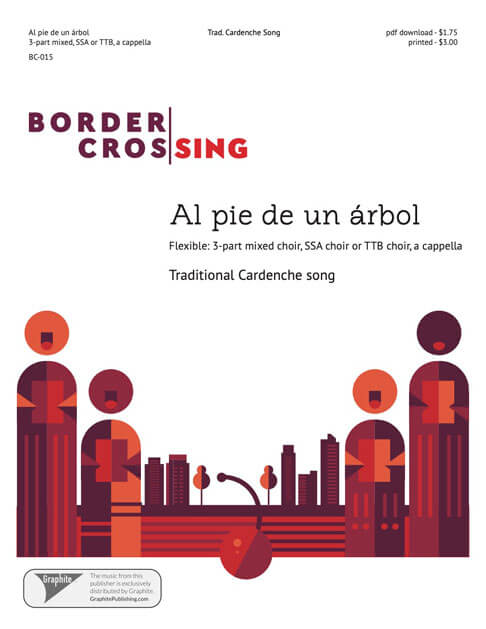
Al pie de un árbol
Traditional Cardenche song
A classic song of the cardenche tradition.
Flexible: 3-part mixed choir, SSA choir or TTB choir, a cappella
Composer’s Notes
Cardenche singing is a genre of unaccompanied polyphonic singing from the Comarca Lagunera, a region in northern Mexico located at the intersection of the states of Chihuahua, Coahuila, and Durango. The word “cardenche” refers to a type of cactus that grows in this region. The cardenche cactus has hooked barbs that make them very painful, as they rip apart the flesh when they are extracted. In the same way, cardenche songs are meant to be “ripped out” of your body.
The essence of cardenche singing lies in capturing the extreme emotion of the text in the vocal tone and range. Themes that are common in cardenche singing are grief, death, and lost love. Cardenche songs are transmitted in the oral tradition and typically sung with people sitting or standing very close to each other, with very long pauses between each phrase. They are sung by three or four different voice parts, each with its own unique role and sound. “Al pie de un árbol” is a classic song of the cardenche tradition. The protagonist under a tree on a hill watching the sun rise, thinking of lost love. It is implied that they have been sitting under the tree all night and are contemplating ending their own life.
This song has three voice parts: the principal, contralta, and arrastre:
emotionally while navigating the extreme high notes with a full-bodied tone that pierces the soul; the contralta is the “thorn” of the cardenche cactus. In most cardenche songs, the contralta sings harmony; this song is an exception, with it carrying the melody and lead.
the principal singer determines the key and general tempo, and the principal always begins each phrase, with the other voices joining in harmony afterward. To sing the principal, it is essential to have accurate intonation, a clear tone without excessive vibrato, excellent diction, and a confident sense of rhythm.
melody and sliding from pitch to pitch. This dragging voice is one element that gives cardenche song its unique sound. Its role is to remain coordinated with the lead voice while also creating a strong foundation for the highest voices to move freely. Arrastre singers are often low basses or altos that sing with a rough, guttural vocal tone, which has led to this voice often being known as the “marrana” (Spanish for “pig”.)
Very few people today know and sing in the cardenche tradition, and for some time it was on the verge of disappearing
entirely. Los Cardencheros de Sapioriz, singers based in the town of Sapioriz, Durango, have made it their mission to teach this genre of music to a new generation. They have toured the world and travel around Mexico to perform and teach the style, both in the traditional way and also developing a “choral style” of cardenche together with several Mexican choir directors. All of Border CrosSing’s proceeds from the sale of this score will be donated to Los Cardencheros de Sapioriz to help them fund this work.
– Ahmed Anzaldúa
Text
1. Al pie de un árbol
mi alma se encuentra triste y aluminada
con la luz de la mañana.
Salió y me dijo que era esperanza vana
donde a la vez mejor me duermo yo.
2. La vide venir
mas no creía que era ella,
yo me acerqué hacia el pie de su ventana.
Salió y me dijo que era esperanza vana
donde a la vez mejor me duermo yo.
3. Quisiera ser
una garza morena pa’estarte mirando
en una redoma de oro.
Pero trigueñita, nomás que me acuerdo lloro
¿Quién tiene la culpa? Usté que me abandonó.
TRANSLATION:
1. At the foot of a tree
my soul sits sad and illuminated
by the morning light.
It came out and told me that hope was in vain
where it is better for me to sleep.
2. I saw her come
but I did not believe it was her,
I went close to the foot of her window.
She came out and told me that hope was in vain
where it is better for me to sleep.
3. I would like to be
a brown heron so I could watch you
on a golden hill.
But blond girl, just to remember I weep
Whose fault is it? Yours, you that abandoned me.
$1.75 per licensed PDF