
Shop for Music
About the Composer

Luke Mayernik
Graphite Publishing
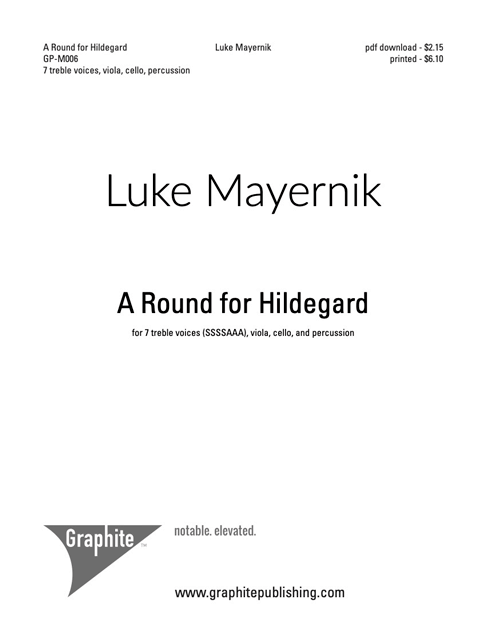
A Round for Hildegard
Melodies that echo simple mirth, coupled with florid, repetitious motifs from stringed instruments.
7 treble voices, viola, cello, percussion
Melodies that echo simple mirth, coupled with florid, repetitious motifs from stringed instruments and early Renaissance pulses set the stage for the Christmastide celebrations found in any 16th century English castle or countryside.
Composer’s Notes
Melodies that echo simple mirth, coupled with florid, repetitious motifs from stringed instruments and early Renaissance pulses set the stage for the Christmastide celebrations found in any 16th century English castle or countryside. A round is a musical composition in which two or more voices sing exactly the same melody (and may continue repeating it indefinitely), but with each voice beginning at different times so that different parts of the melody coincide in the different voices, but nevertheless fit harmoniously together. “A Round for Hildegard” desires to take the listener by the hand into a world of ‘merry voices and viols.’
It is important the point out the metrical changes that occur at mm. 59, 79, 81, 83, and 104, respectively. The eighth-note should always maintain an equal value between the 2/4, 4/4 and 6/8 time signatures. By implementing the constant pulse and value of the eighth note, the contrasting sections and varied ‘moods’ of the piece will effortlessly change and transitions will be smoothly executed.
Text
Alleluia.
Res Miranda.
Pares Forma.
Gaudeamus.
Transeamus.
– from the English carol “There is no rose,” c. 1420
Translation:
Alleluia.
Wonderful thing.
Equal in form.
Let us rejoice.
Let us follow.
$2.15 per licensed PDF
Music from Graphite Publishing
-
-
-
A Child’s Prayer at Evening
Difficulty: 2Duration: less than 3 min. -
Orange-Mounts of More Soft Ascent
Difficulty: 5Duration: less than 3 min.



Reviews
There are no reviews yet.