
Shop for Music
About the Composer

Timothy C. Takach
Timothy C. Takach Publications
As the Sunflower Turns on Her God
A gorgeous fusing of music and mathematic principals brilliantly blurs the line between art and science.
SSAATBB a cappella, Sop. solo
Takach has written a piece that not only explores the math within music but also sounds fantastic on stage. Singers will love the stepwise harmonies in the many parts, and the Greek text is easy to pronounce. The soprano solo features long lines and is in beautiful rhythmic contrast to the choral texture underneath. Offer your singers and audience a breath of fresh air with this piece – music to simply experience and enjoy.
Composer’s Notes
“As the Sunflower Turns on Her God” translates two related mathematical concepts into music – the golden ratio and the Fibonacci sequence.
The golden ratio (Phi) is a precise ratio that occurs when a line segment (A+B) is divided into two smaller segments, and the ratios of the larger segment (A) to the smaller (B) and the whole segment (A+B) to the larger (A) are equal. The brilliant part is that the golden ratio occurs naturally in things like roses, pinecones, and other plants. It is also believed to be one of the most aesthetically pleasing proportions and is sought after and desired in art, architecture, and in this and few other cases, music. In my research, I came across a book called The Golden Ratio by Mario Livio. In one of the chapters he shows the presence of the golden ratio in the spacial distribution of leaves on plants and in the spirals found in the head of a sunflower. The chapter’s title is “ As the Sunflower Turns on Her God,” a line from a Thomas Moore poem.
The Fibonacci sequence was discovered by Leonardo of Pisa (Fibonacci) in the early 13th century in his book Liber Abaci. He posed a question using the reproduction rate of rabbits as his example, and discovered a sequence of numbers where, starting with 1, one adds the current number to the previous number to get the next number. So 1+0=1, 1+1=2, 2+1=3, 3+2=5, and so on. The se- quence looks like this: 1, 1, 2, 3, 5, 8, 13, 21, 34, 55, 89, 144…
Dividing a number in the Fibonacci sequence by its predecessor gives us a close approximation to Phi. As you perform this function higher and higher in the sequence, the answer is alternately higher and lower than Phi; approaching it, but never reaching it. I assigned each number in the Fibonacci sequence (up to 34) to a chord based off of its corresponding scale degree. The 8th scale degree returns to tonic, so 1=i, 2=II, 3=iii, 5=v, 8=i, 13=vi, 21=vii, and 34=vi. These chords formed the progression of the piece; starting with one chord in the first phrase, and then add- ing an additional chord of the sequence to it in each successive phrase: i, i-i-i, i-i-II-i-i, i-i-II-iii-II-i-i, i-i-II-iii-v-iii-II-i-i, etc. As the piece began to take form, I took liberties in the major or minor tonality of each chord, decidedly crossing the line from science into art.
Having made this decision, I still needed a text. Part of the intrigue behind Phi is that the decimal approximation goes on forever without repeating, so the choir sings this number in Greek (usage of Phi can be traced back to Euclid and Pythagorus in ancient Greece) to 74 decimal places (the first “ ena” and “ stigme” (1.) don’t count). By the end, the rhythmic alto pedal point has extended that to 82 decmial places. I also wanted to include Fibonacci’s original question about rabbits, so I gave that text to the soprano solo. It is the original Latin text from his book, Liber Abaci.
– Timothy C Takach
Text
ena, stigme, hex, ena, okto, zephyron, treis, treis, ennea, okto, okto, hepta, tettara, ennea, okto, ennea, tettara, okto, tettara, okto, dyo, zephyron, tettara, pente, okto, hex, okto, treis, tettara, treis, hex, pente, hex, treis, okto,
ena, ena, hepta, hepta, dyo, zephyron, treis, zephyron, ennea, ena, hepta, ennea, okto, zephyron, pente, (quintet) hepta, hex, dyo, okto, hex, dyo, ena, treis, pente, tettara, (tutti) tettara, okto, hex, dyo, dyo, hepta, zephyron, pente, dyo, hex, zephyron, tettara, hex, dyo, okto, ena, (okto, ennea, zephyron, dyo, tettara, tettara, ennea, hepta,)
– decimal equivalent of Phi
Quidam posuit unum par cuniculorum in quodam loco, qui erat undique pariete circumdatus, ut sciret, quot ex eo paria germinarentur in uno anno.
– Fibonacci (Leonardo of Pisa)
– sung in Greek
Translation:
A certain person placed one pair of rabbits in a certain place that was on all sides surrounded by a wall, so that he might learn, how many pairs would be produced from it in one year.
– trans. Anne Groton
Phi
(decimal approximation) 1.61803398874989484820458683436563811772030917 98057628621354486227052604628189024497…
$1.60 per licensed PDF
Music from Timothy C. Takach Publications
-
-
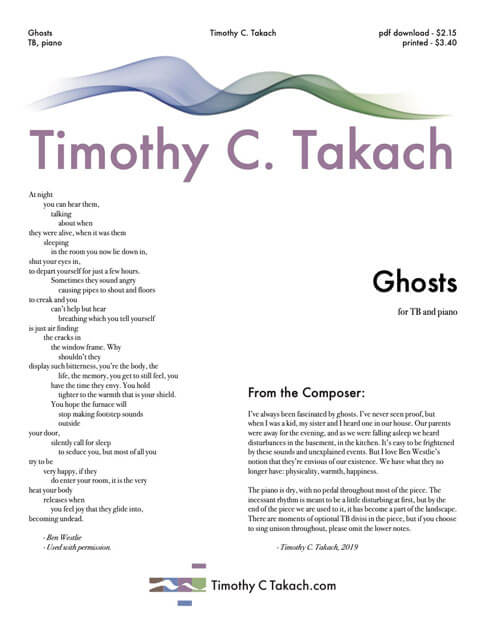
Ghosts
Difficulty: 2Duration: less than 3 min. -
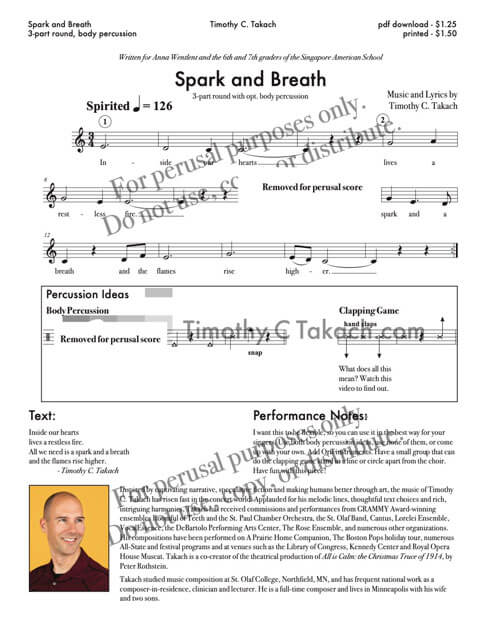
Spark and Breath
Difficulty: 2Duration: less than 3 min. -


Reviews
There are no reviews yet.